

oblako
oblako is a local AWS platform: run Bedrock, SageMaker, Redshift, Step
Functions and more on your laptop, no cloud required. You write the AWS code you
already write, every service maps 1:1 to a boto3 client, and oblako runs it
against real local engines wired into an AWS-shaped topology.
import boto3
s3 = boto3.client("s3")          # -> S3Proxy, real S3 API over the filesystems3.create_bucket(Bucket="demo")
ddb = boto3.client("dynamodb")   # -> DynamoDB Localddb.list_tables()
The difference from a mock: a bucket really stores bytes, a redshift-connector
session really runs SQL, a SageMaker job really trains in a container. oblako
simulates the topology (clusters, endpoints, control planes) around engines that
are doing the work. Real behavior, simulated topology.
Documentation → · oblako on GitHub →
Quick start
Section titled “Quick start”oblako needs Python 3.10 or later and a container runtime: Docker (the default),
Podman, Colima, or Apple’s container. Most services run as containers. A few
API engines run in Python without one.
pip install oblako         # or: uv tool install oblako
oblako up                  # start the servicesoblako configure           # write the `oblako` AWS profileexport AWS_PROFILE=oblako  # point boto3 and the AWS CLI at oblakooblako dashboard           # web UI at http://localhost:8000
Your unmodified boto3 code and the AWS CLI then reach the local services, with
no endpoint_url in the code. Select another AWS profile and the same code
talks to AWS.
Extras
Section titled “Extras”Optional dependencies for specific workloads:
| Extra | Adds |
|---|---|
oblako[sagemaker] | The SageMaker SDK v3, for code that drives it against oblako and for its local modes |
oblako[mlflow] | A local MLflow tracking server |
oblako[iceberg] | pyiceberg for reading and writing tables through the local Iceberg catalog |
oblako[parquet] | Firehose record format conversion from JSON to Parquet |
oblako[mysql] | The MySQL driver for RDS MySQL |
oblako[agentcore] | The bedrock-agentcore SDK for local AgentCore agents |
oblako[notebook] | JupyterLab for oblako notebook |
pip install "oblako[sagemaker,parquet]"What runs locally
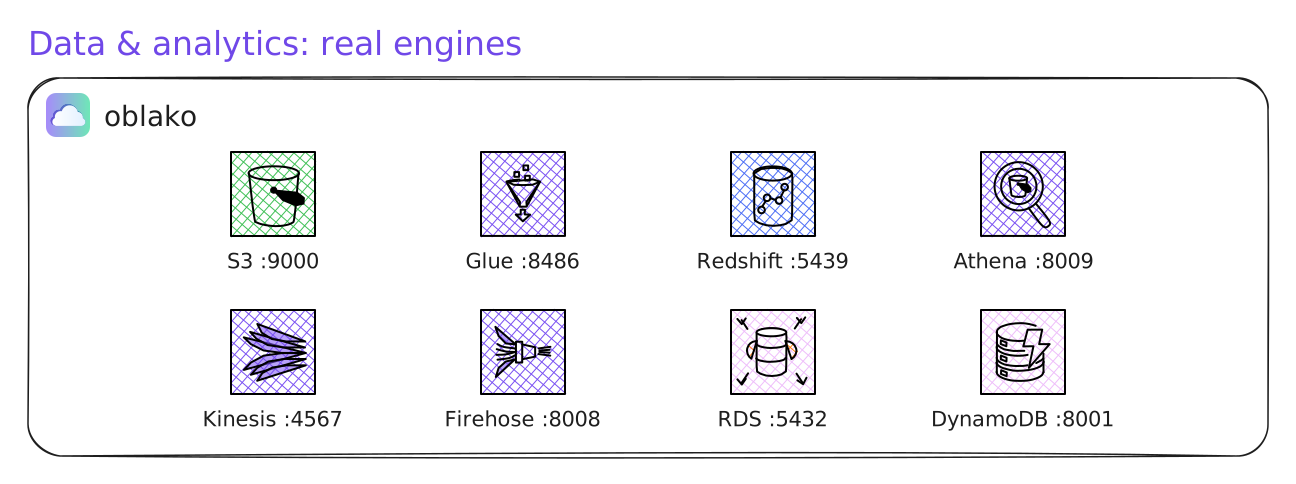
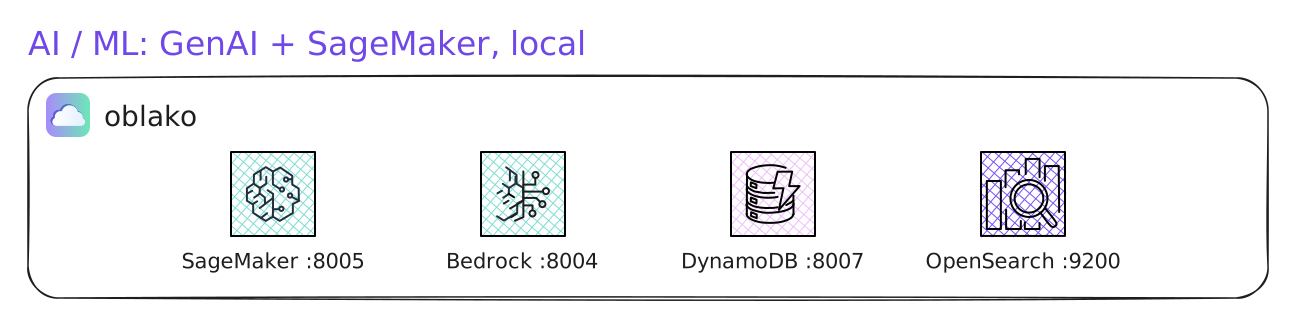
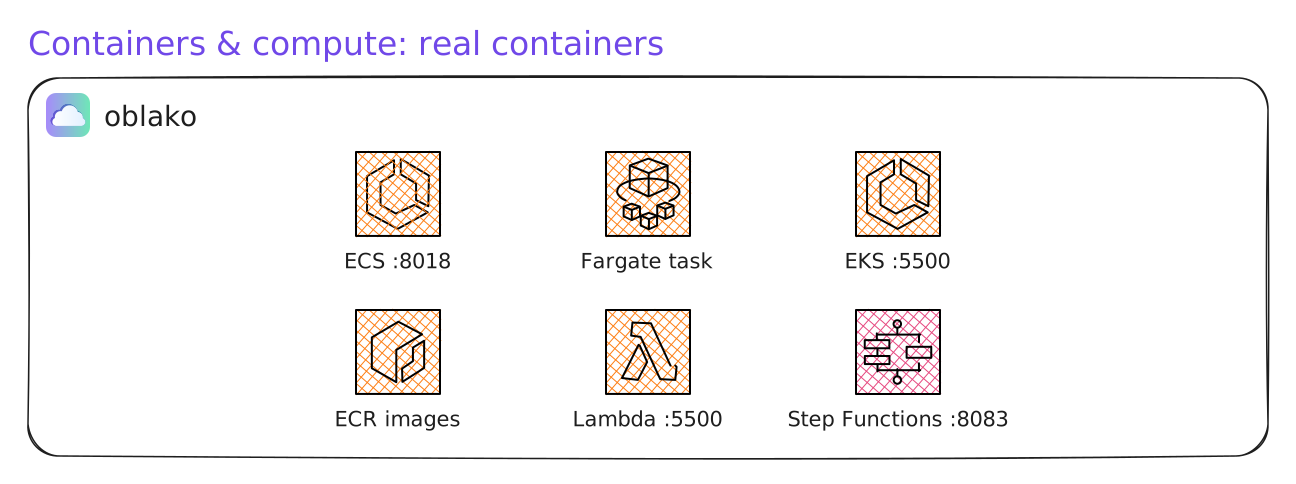
Section titled “What runs locally”Each service is a real engine on a fixed local port, reached by the same
boto3 client (or native driver) you’d use in the cloud.
| AWS service | Local replacement | How |
|---|---|---|
| Bedrock (LLMs) | Ollama (or OpenRouter) | boto3 bedrock-runtime invoke and converse. The OpenRouter backend hits real models with your key |
| Bedrock (control plane) | oblako server | boto3 bedrock: foundation-model catalog and batch model-invocation jobs |
| Bedrock Knowledge Bases | OpenSearch | Vector search with k-NN |
| Bedrock AgentCore (Runtime) | bedrock-agentcore SDK | Local agent on the /invocations and /ping contract |
| SageMaker | oblako engine + SDK v3 local mode | boto3 sagemaker runs jobs and endpoints in real Docker. ModelTrainer / ModelBuilder local mode runs with no account |
| Step Functions | aws-stepfunctions-local | Official AWS Docker image |
| Lambda | AWS SAM CLI (external) | sam local invoke, bring your own SAM CLI |
| ECS / Fargate | moto + container per task | run_task / create_service launch real containers. A Fargate + ALB CloudFormation stack deploys and serves locally |
| ELBv2 (ALB) | moto + Caddy proxy per LB | Real reverse proxy round-robining to tasks with the target group health check |
| S3 | S3Proxy | S3 API over the local filesystem |
| S3 Tables | oblako server + Iceberg REST catalog | boto3 s3tables. Tables are real Iceberg, queryable by Athena, Trino and pyiceberg |
| S3 Vectors | oblako server | boto3 s3vectors: vector buckets, indexes and k-NN QueryVectors |
| DynamoDB | dynamodb-local | Official AWS Docker image |
| Kinesis | kinesalite | Kinesis Data Streams |
| Firehose | oblako server | boto3 firehose delivery streams, buffered and flushed to S3 or Redshift |
| Athena | oblako server + Trino | boto3 athena. Queries run on Trino, results go to the S3 output location |
| Redshift (engine) | oblako image (PostgreSQL 16) | Impersonates Redshift: redshift-connector natively, system tables, SET query_group, UDFs |
| Redshift (management API) | moto | boto3 redshift control plane: clusters, nodes, endpoints |
| Redshift Data API | oblako server | boto3 redshift-data, real SQL against the engine |
| Redshift ML | Training container + plpython3u | CREATE MODEL from any SQL client, trained asynchronously in a container. The prediction function runs in-DB |
| RDS / Aurora | moto + PostgreSQL / MySQL | boto3 rds control plane and a real engine |
| RDS Data API | oblako server | boto3 rds-data: synchronous SQL and transactions |
| CloudFormation | oblako server | boto3 cloudformation (and aws cloudformation deploy / sam deploy) creates real oblako resources |
| Glue | Spark + S3Proxy | Spark jobs read and write oblako’s S3 |
| Glue Data Catalog | oblako server | boto3 glue databases, tables, partitions and crawlers. It is Athena’s AwsDataCatalog |
| MWAA (Airflow) | AWS’s MWAA Airflow image | boto3 mwaa. Each environment runs real Airflow, with DAGs synced from S3 |
| EventBridge | moto + oblako proxy | boto3 events. Scheduled rules fire and run their targets |
| EKS | moto | boto3 eks control plane: create, describe and list clusters |
| API Gateway | AWS SAM CLI (external) | sam local start-api, bring your own SAM CLI |
| AppConfig | oblako agent | Python reimplementation of the feature-flag and A/B split |
Per-service guides and limitations are in the services documentation.
| Command | Description |
|---|---|
oblako up [service] | Start all services, or one, and wait for each to be ready. Exits 1 if any is not, so a CI step fails there |
oblako down [service] | Stop all services, or one |
oblako status | Show service status |
oblako configure | Write an oblako AWS profile whose per-service endpoints are oblako’s. Other profiles are left as they are |
oblako dashboard | Start the web dashboard on 127.0.0.1:8000 |
oblako notebook | Launch JupyterLab wired to oblako |
oblako logs <service> | Show logs for a service |
oblako pull [model] | Pull a model into the Bedrock engine |
The full command list is in the quick start guide.
Container runtimes
Section titled “Container runtimes”oblako isn’t hard-wired to Docker. Every service runs through a pluggable
backend, selected with OBLAKO_CONTAINER_BACKEND: docker (default), podman,
colima, kubernetes, or Apple’s container (apple). See the
runtimes guide.
The book
Section titled “The book”A Data Guide to AWS on oblako walks through the AWS data services as they run on oblako, chapter by chapter, with code you can run: S3, Glue and Athena, Redshift, RDS, DynamoDB, streaming, Spark with Iceberg, MWAA, testing in CI, and moving to AWS.
Read it online → · Download the PDF →
Documentation
Section titled “Documentation”Service guides, architecture, the dashboard, container runtimes, and the Python API reference live at oblako-sdk.almostly.ai.
License
Section titled “License”oblako is open core. The open-source edition is licensed under the Apache License 2.0. Commercial Pro and hosted editions are offered separately under their own terms.
oblako orchestrates third-party engines (moto, S3Proxy, Trino, Postgres, and
others) that it pulls at runtime rather than redistributing. Each keeps its own
license, inventoried in
THIRD_PARTY_LICENSES.md.
Subscribe to oblako updates
We’ll email you when oblako ships a new release or a notable change. No spam.